Scotland

Amanuensis Monday – A Mother’s Remembrance

The Campbell’s were poets at heart and when Janet Waddell Ross Campbell heard of the death of her son she started writing. This is a transcription of the poem written by Janet.

In Memoriam

Horace Gibson Leitch Campbell

(Written by his Mother – 1916)

Hearts are breaking, tears are falling;
High hopes withered in the dust.
Our dear Land’s in sorrow shrouded
Thro’ oppression, hate and lust.
Raise we then our Holy Standard
“Peace on earth, Goodwill to men!”
As at the Holy Infants birth
Angels sang in concert then.
Christ, the Man, our Valiant Captain
Shall this righteous Peace secure
End the din and strife of warfare
Making holiness endure!

Great Consoler, let us trust thee
Who is our sorrow comfort gives,
In the loss of our dear loved one
May we feel that he still lives!
Bravely he marched back to duty
But – – four days after leaving home,
Struck by shell! He in an instant
Was by cruel death o’ercome
O’erpassing death, his soul soared upward
Through deathless tracts straight to his God
Now we look above and see him
Though his body’s ‘neath the sod.

Laid to rest by dear, brave comrades,
Who twined a wreath of wild-flowers fair,
Emblem of his Captain’s sufferings – –
A wooden Cross they too placed there.
In a cemet’ry in Flanders,
Loving hands these graves attend.
To all those noble, gentle, kind hearts,
Gratefully our thanks we send.
Comfort Lord, our dear, brave soldiers,
Striving, fighting for the right;
Heal the wounded, soothe the dying,
To all bereaved ones send Thy Light.

Calmly then we trust thee Saviour
Who can make glad thoughts arise
As we each on God’s great altar
Lay our precious sacrifice.
Memories dear around us hover
Like Holy incense’ sweet perfume
Pleasant, happy acts of kindness
Which he lives but to resume
Beloved by all, dear son and Brother
A great glad meeting is in store
Each in God’s good time shall greet thee
Where partings cease for ever more.
Lovingly we leave thee dear one
Knowing well thou’rt safe from harm
Lasting peace is now thy portion
No more thou hearest war’s alarm.

Janet Waddell Ross Campbell wrote this poem in honour of her son. She used the first line and every other line to spell out his name, Horace Gibson Leitch Campbell.

After spending his leave from wartime France with his family, Horace Gibson Leitch Campbell left the home of his parents on the night of 4 June 1916. It was the eighth birthday of his niece, Norah Margaret Campbell. He was killed four days later on 8 June 1916.

©2010 – Blair Archival Research
Ordnance Gazetteer of Scotland at Electric Scotland

The Ordnance Gazetteer is a good resource for maps of Scotland.

There are six volumes to this gazetteer. You have county maps, city maps, and pictures of castles, the prospectus and a General Survey of Scotland. The dates for the Gazetteer appear to be 1892-1896.

The maps take a while to download but they have a lot of detail. When your cursor moves over the map it allows you to chose the sections you want magnified. Once you have magnified a section you can move the side and bottom bars in your browser to move the map.

In volume six there is a General Survey of Scotland where you will find an A to Z of towns. Here you click on the first letter of the town name and you will be presented with a list of towns beginning with that letter in alphabetical order. When you find the one you want there is a page number and when you click on it you will be taken to a written description of the town.

One pet peeve I have is the tool bar and the pop ups. On the right hand side of the tool bar is an option to minimize it so I would suggest you do so. There are also some other pop ups that appear but once you get into the larger version of the map you will not be bothered by them.

©2010 – Blair Archival Research

Amanuensis Monday – A Family Treasure from John Sheddens Campbell

My Great Great Grandfather was John Sheddens Campbell. He lived in Glasgow where he raised his large family, 18 children from two marriages. John Sheddens Campbell started out his working life as a blacksmith as was his father before him. When his working life ended he was the owner of James Boardman Company where he was a die sinker and engraver. He started in the company as a clerk and then a brand cutter and traveler. He took over the company in 1866.

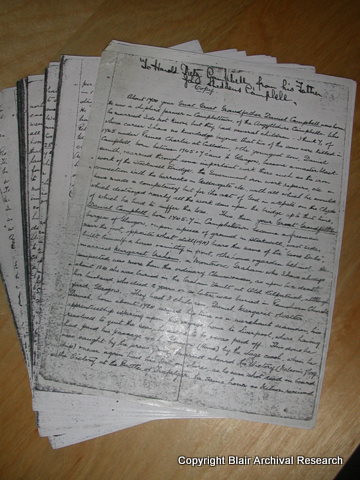
At the end of his life John Sheddens Campbell was blind. Several of his sons had immigrated to British Columbia and he decided to dictate a family history to my Great Grandfather Frederick Thomas Campbell to be sent to his other son Harold Dietz Campbell who was living in Vancouver.

I don’t know when the copy of it came into the hands of my family. I always remember my Grandmother having a copy. It was rolled up with an elastic band around it. When I got it I put it under my mattress to flatten it out so that it could be read and transcribed.

It is doubly special to me as it is the words of my Great Great Grandfather as written by my Great Grandfather.

The document is eleven pages long and on the top is written “To Harold Dietz Campbell from his Father John Sheddens Campbell.” From the handwriting and ink it does not appear to have been written at the time of the documents creation. At the end of the family history is another note “All the foregoing was written from memory in September 1911 by John Sheddens Campbell who died 4th May 1918, aged 78 years.” Now I know that the information after 1911 was added by someone else. The previous part of the message is in the same ink and hand as the document.

The family history covers John Sheddens Campbell’s maternal and paternal sides. It is written with the relationships being described as those to John Sheddens Campbell and Harold Dietz Campbell. So they talk about John and Harold’s Aunt, cousin, Great Grandfather, etc.

John starts with his Great Grandfather around 1700. He mentions that a couple of his sons were killed at the Battle of Culloden under Prince Charlie in 1745. Next is John’s Grandfather who did iron work on the Stockwell Bridge in Glasgow. He built his home and smitty in Goose Dubs and the name is still used in the area today. He married Margaret Graham of the Montrose Graham’s and they had three children. Their son John who was working on sailing vessels had been paid off and was on his way home when he was press ganged into service on the Victory and was killed at the battle of Trafalgar. This fact has yet to be proven.

His other son Walter was a solider and fought under Wellington in 1810. He describes all the battles, his regiment, pension and his medals. Walter was also among the first to become “teetotal and join that movement in Glasgow in 1830.”

Now while he is going through the family connections he says things like “Aunt Mary” “Mrs. Sherriff” and “you know about them so I will not go into detail here” which is very frustrating from a researchers point of view.

John Sheddens Campbell describes first and second marriages and families. Some went to Australia and he says that Harold knows about them as he met them during his visit. When John talks of his half brothers going to Australia he says “they corresponded regularly with home for 9 years – that is to 1857 since then all knowledge of them …has ceased, though for 50 years or more I have tried many ways to discover any of them, but have failed all along the line.”

His maternal side starts around 1740 with the reference to a French refugee called “Guiliamus something?” who changed his name to William Robertson. When talking of his Grandmother and the land she owned he provided the 1911 street names where the land was located.

He describes their attributes, how, when, where deaths, births, marriages and other events happened. At one point he describes how a family member immigrated to South Africa and how “mother,” his wife, corresponds with them. I found this interesting when I ended up corresponding with their Great Great Granddaughter in South Africa eighty years later.

He did make a few errors. He got the name of his maternal Grandfather wrong. He left out several bits of information that during the Edwardian period people would not talk about but have since been discovered.

The document is too long to fully transcribe here but I have transcribed it and it has been published in the “Journal of the Glasgow & West of Scotland Family History Society” Newsletter No 76, June 2006.

Still when all is said and done this is a wonderful little treasure to have when you begin your family history research. I have referred to it often and reread it many times. Each time finding something new that I either had not noticed or did not remember.

Thank you John Sheddens Campbell.

©2010 – Blair Archival Research